HONEXT
High-performance fibre boards made from paper sludge. Circular by design, Barcelona.
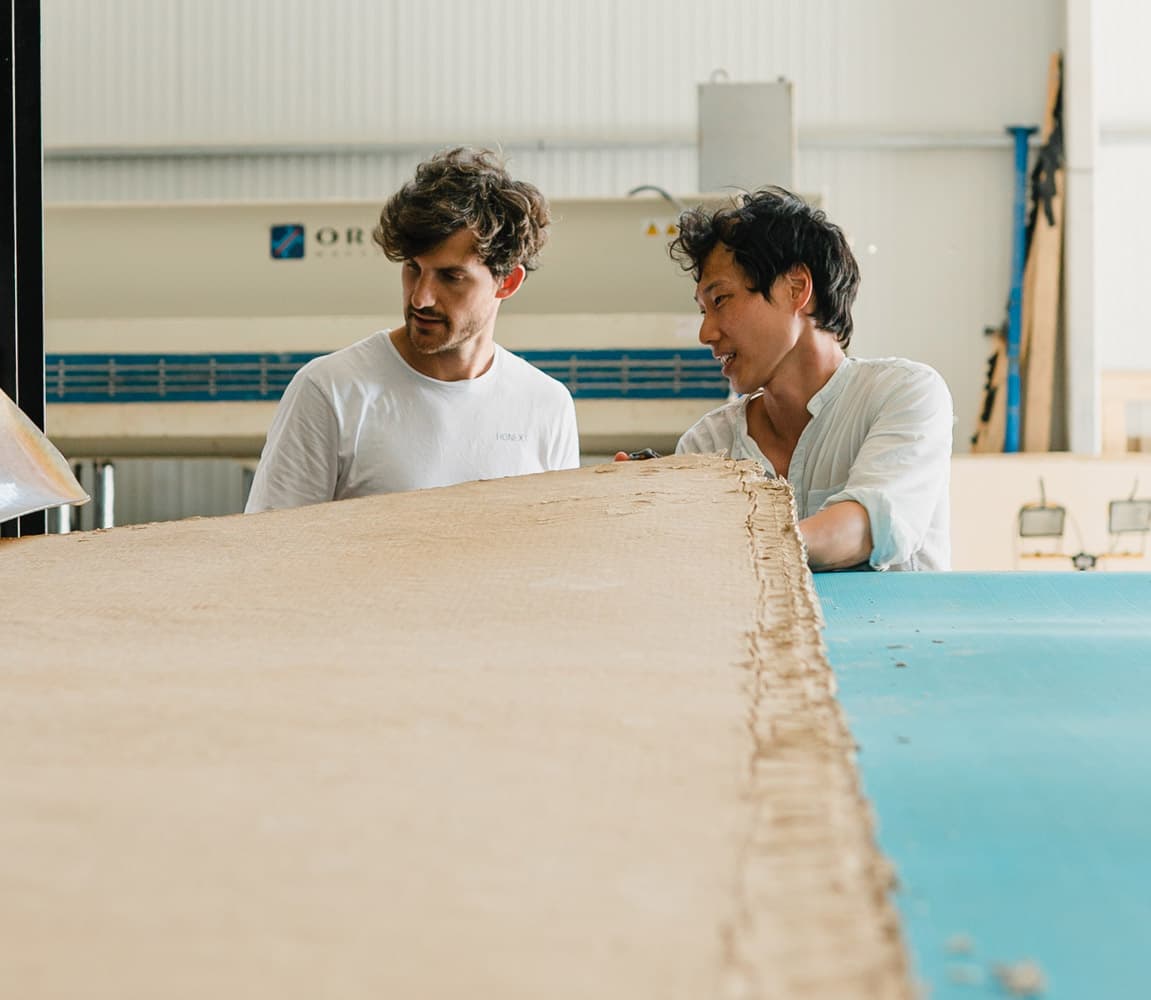
HONEXT is a high-performance construction board made in Barcelona from cellulose fibre and paper sludge — waste from the paper industry — activated with enzymes, with no toxic resins or formaldehyde. Fully recyclable and designed with circular economy criteria (Cradle to Cradle certification), it offers better acoustic and thermal insulation than conventional MDF, is moisture-resistant and flame-retardant. It is used in acoustic panels, cladding and partition walls.
Innovative, using 100% industrial waste as raw material. Cradle to Cradle Gold certification.
Chosen by Descarboniza. No company pays for what we say about it.
Go to their websiteEuroclase C-s1,d0 (B-s1,d0 en versiones recientes)
Paneles acústicos, revestimiento, paredes de partición
Paneles acústicosrevestimiento muralparedes de particiónmobiliario. 100% residuo industrial.
Sí
DAP verificada (GlobalEPD EN15804-036, AENOR, EN 15804+A2; 17-04-2023→16-04-2028): unidad 1 m³ de tablero de fibra celulósica reciclada (510–600 kg/m³). GWP-total A1–A3 = −730 kg CO₂eq/m³ (clase C-s1,d0; clase B-s1,d0: −709); GWP-fósil +92,5. El total negativo es carbono biogénico que se reemite en fin de vida (C3 +658). Además Cradle to Cradle (que no es una EPD). PDF: honext.eu (DAP-GlobalEPD-EN15804-036).
Claim your listing: add your EPD, stand out in the comparator and appear right where the technician chooses the material.
Upgrade your listingTechnical questions and answers
- What is the carbon footprint (GWP) of HONEXT?
- HONEXT declares a GWP (A1–A3) of -730 kg CO₂e/m³.
- What is the fire resistance of HONEXT?
- The declared fire performance of HONEXT is Euroclase C-s1,d0 (B-s1,d0 en versiones recientes).
- Does HONEXT have an Environmental Product Declaration (EPD)?
- Yes. HONEXT has a verified EPD.
- Is HONEXT a carbon-negative material?
- Yes. The biogenic carbon stored in HONEXT exceeds its manufacturing emissions (A1–A3), according to its environmental documentation.
Values as declared by the manufacturer or its EPD. Always check the current EPD/technical sheet for project-critical calculations.