What is the best insulation for a house in Extremadura?
Reviewed on 7 September 2026
Expanded cork on the facade, a wood-fibre board on the roof, and blown cellulose if you are retrofitting without opening the walls. In Extremadura the problem is summer, not winter: 265 of its 388 municipalities sit in climate zone C4 of the Spanish Building Code, and that 4 is the highest summer severity on the scale. A light insulation stops the cold as well as a heavy one with the same conductivity, but against July heat what counts is how much mass stands between the sun and you. We calculated it: on a roof insulated from the outside, 14 centimetres of wood fibre delay the heat wave by eight and a half hours; the same roof with mineral wool, three.
All three picks hold a verified environmental declaration that we have read and that is still valid. That is not a detail: most of the insulation products in the directory don't have one, and among those that don't are the two cork manufacturers from Extremadura itself.
Our picks
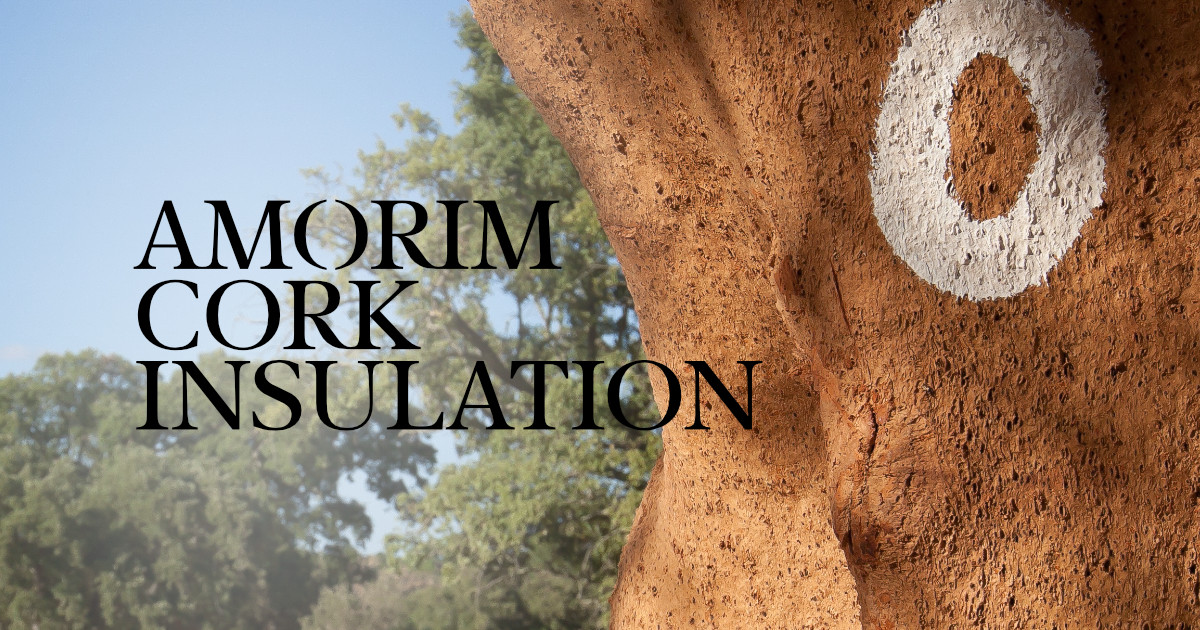 Our pick for facades
Amorim Cork Insulation
Expanded cork at 100 to 120 kg/m³ and 0.040 W/m·K, with its own declaration valid to 2028 and the most negative footprint in the directory: −2,040 kg CO₂e per cubic metre. Made in Aveiro, Portugal, from the same cork oak that grows in the Extremaduran dehesas.
View entry → For the roof
Steico aislamientos
Rigid wood-fibre board at 140 kg/m³ and 0.040 W/m·K, with its own declaration valid to 2031 and −135 kg CO₂e per cubic metre. It puts the most mass between the sun and the ceiling. The declaration covers the group's Polish plant.
View entry → If you are blowing into a cavity
ISOCELL GmbH & Co KG
Recycled-paper cellulose, 0.038 W/m·K at 45 kg/m³, with a 2024 declaration in the IBU programme: −1.42 kg CO₂e per kilo. It is the way to insulate an existing house without opening the walls. None of the Spanish cellulose manufacturers in the directory holds a valid declaration today.
View entry →
Reference prices
| Material | Work item | €/m² | Price date |
|---|---|---|---|
| Amorim Cork Insulation | SATE con panel de corcho expandido ICB de 100 mm, colocadoBase de Precios de la Construcción de Extremadura 2025 (v.1), partida L02EA090, precio de 2024-04-01. Ámbito: Extremadura. · L02EA090 | 52,92 €/m² | 2024-04-01 |
| Steico aislamientos | Panel de fibra de madera de 140 mm sobre cubierta inclinada, colocadoBase de Precios de la Construcción de Extremadura 2025 (v.1), partida L02H060, precio de 2024-04-01. Ámbito: Extremadura. · L02H060 | 50,64 €/m² | 2024-04-01 |
| ISOCELL GmbH & Co KG | Generador de precios de la construcción CYPE, partida NVE050, precio en España, sin fecha de edición; la base extremeña no tiene partida de insuflado | 13,73 €/m² instalado, cámara de 70 mm a 45–50 kg/m³ | 2026-09-07 |
Installed unit price, labour included, as the source publishes it. A reference for budgeting, not an offer: the real price comes from the installer.
Who this is for
For anyone building or retrofitting a home in Extremadura who has to choose the insulation for the roof, the facade or the cavity, and wants to justify it with a document rather than a brochure.
It is not for anyone looking for the cheapest option: we hold no verified prices, and we say so below. And it does not replace the engineer's calculation: the Building Code requires justifying the consumption of the whole building (HE0), not just the U-value of each wall.
How we chose
First, a verified environmental declaration, read by us and still valid. If there is no document, or it has expired, the material is not featured however good it is.
Second, high density at equal conductivity, because in Extremadura the enemy is summer.
Third, a clear use: an external facade, a roof and a cavity filled through a hole don't ask for the same thing, so there is one pick for each rather than a single winner.
Fourth, distance: all else being equal, we prefer what is made in the Iberian Peninsula. We have not weighed price, because we hold no verified prices.
What shapes the answer
The Building Code classifies each municipality with a letter for winter and a number for summer. Extremadura has 265 municipalities in C4, 106 in D3, 15 in C3 and 2 in E1. Badajoz, Cáceres, Mérida and Plasencia are C4; Zafra, Hervás or Guadalupe, by altitude, D3. A summer 4 is the top of the scale.
For winter, DB-HE1 sets limit U-values: in zone C, 0.49 W/m²K for facades and 0.40 for roofs; in zone D, 0.41 and 0.35. With an insulation of conductivity 0.040, meeting the limit with the insulation alone takes roughly 8 to 10 cm on a facade and 10 to 12 on a roof, before counting the other layers. Those are minimums: HE0 usually pushes for more.
For summer there is no single number in HE1 that settles it. What delays the heat is mass, and where that mass sits matters. In a light roof the insulation is almost all the mass there is, which is why the gap between a dense board and a light batt runs to hours. In a brick facade the wall itself already delays the heat by six hours with any insulation on top, and cork adds another hour and a half. In a cavity filled by blowing, cellulose and mineral wool end up almost level, because the bricks provide the mass. The figures, calculated under ISO 13786, are further down with every layer and its source.
How we tested
We calculated the summer behaviour of three typical build-ups under EN ISO 13786, with a 24-hour period: how many hours the outdoor heat wave takes to show up inside (time lag) and what fraction of the outdoor swing reaches the interior (decrement factor). Every layer carries its source. Your wall won't be exactly this one; the order of magnitude will.
Cubierta inclinada, aislada por fuera
Es donde más pega el sol en Extremadura. Teja, cámara, aislante sobre el tablero, y placa de yeso por dentro: el esquema habitual de una cubierta aislada por el exterior. Se comparan tres aislantes con el mismo espesor, 140 mm, que es lo que un presupuesto especifica.
| Option | Time lag | Decrement | U | Mass |
|---|---|---|---|---|
| Fibra de madera 140 mm | 8.5 h | 0.5 | 0.25 W/m²K | 81 kg/m² |
| Lana mineral 140 mm | 3.2 h | 0.92 | 0.22 W/m²K | 67 kg/m² |
| EPS 140 mm | 2.7 h | 0.93 | 0.23 W/m²K | 64 kg/m² |
Layers, outside to inside
- Fibra de madera 140 mm: Teja de arcilla cocida (20 mm, λ 1, ρ 2000, c 800; CEC 3.11) → Cámara de aire bajo teja, no ventilada (R 0.16 m²·K/W; ISO 6946 tabla 8) → STEICOspecial dry (fibra de madera) (140 mm, λ 0,04, ρ 140, c 2100; TDS STEICO; ρ de la DAP NEPD-11332) → Tablero de madera de conífera, 22 mm (22 mm, λ 0,13, ρ 500, c 1600; ISO 10456 tabla 3) → Placa de yeso laminado, 12,5 mm (13 mm, λ 0,25, ρ 825, c 1000; CEC 3.6)
- Lana mineral 140 mm: Teja de arcilla cocida (20 mm, λ 1, ρ 2000, c 800; CEC 3.11) → Cámara de aire bajo teja, no ventilada (R 0.16 m²·K/W; ISO 6946 tabla 8) → Lana mineral, 40 kg/m³ (140 mm, λ 0,035, ρ 40, c 1030; ISO 10456 tabla 3 (c); λ genérica de catálogo) → Tablero de madera de conífera, 22 mm (22 mm, λ 0,13, ρ 500, c 1600; ISO 10456 tabla 3) → Placa de yeso laminado, 12,5 mm (13 mm, λ 0,25, ρ 825, c 1000; CEC 3.6)
- EPS 140 mm: Teja de arcilla cocida (20 mm, λ 1, ρ 2000, c 800; CEC 3.11) → Cámara de aire bajo teja, no ventilada (R 0.16 m²·K/W; ISO 6946 tabla 8) → EPS, 20 kg/m³ (140 mm, λ 0,036, ρ 20, c 1450; ISO 10456 tabla 3) → Tablero de madera de conífera, 22 mm (22 mm, λ 0,13, ρ 500, c 1600; ISO 10456 tabla 3) → Placa de yeso laminado, 12,5 mm (13 mm, λ 0,25, ρ 825, c 1000; CEC 3.6)
Fachada aislada por fuera (SATE)
La fachada de media asta de ladrillo perforado es la más común en la vivienda extremeña de las últimas décadas. Se aísla por el exterior con 100 mm y revoco, y se comparan tres aislantes con el mismo espesor.
| Option | Time lag | Decrement | U | Mass |
|---|---|---|---|---|
| Corcho expandido 100 mm | 7.8 h | 0.4 | 0.35 W/m²K | 188 kg/m² |
| EPS 100 mm | 6.2 h | 0.43 | 0.32 W/m²K | 179 kg/m² |
| Lana mineral 100 mm | 6.4 h | 0.43 | 0.31 W/m²K | 181 kg/m² |
Layers, outside to inside
- Corcho expandido 100 mm: Mortero de cemento, revoco 15 mm (15 mm, λ 1,3, ρ 1900, c 1000; CEC 3.5 (1800<ρ≤2000)) → Amorim ICB (corcho expandido) (100 mm, λ 0,04, ρ 110, c 1500; TDS Amorim (λ, ρ); c: CEC 3.8, placas de corcho) → ½ pie de ladrillo perforado, 115 mm (115 mm, λ 0,639, ρ 1140, c 1000; CEC 3.11 (R = 0,18 m²·K/W)) → Enlucido de yeso, 15 mm (15 mm, λ 0,57, ρ 1150, c 1000; CEC 3.6 (1000≤ρ≤1300))
- EPS 100 mm: Mortero de cemento, revoco 15 mm (15 mm, λ 1,3, ρ 1900, c 1000; CEC 3.5 (1800<ρ≤2000)) → EPS, 20 kg/m³ (100 mm, λ 0,036, ρ 20, c 1450; ISO 10456 tabla 3) → ½ pie de ladrillo perforado, 115 mm (115 mm, λ 0,639, ρ 1140, c 1000; CEC 3.11 (R = 0,18 m²·K/W)) → Enlucido de yeso, 15 mm (15 mm, λ 0,57, ρ 1150, c 1000; CEC 3.6 (1000≤ρ≤1300))
- Lana mineral 100 mm: Mortero de cemento, revoco 15 mm (15 mm, λ 1,3, ρ 1900, c 1000; CEC 3.5 (1800<ρ≤2000)) → Lana mineral, 40 kg/m³ (100 mm, λ 0,035, ρ 40, c 1030; ISO 10456 tabla 3 (c); λ genérica de catálogo) → ½ pie de ladrillo perforado, 115 mm (115 mm, λ 0,639, ρ 1140, c 1000; CEC 3.11 (R = 0,18 m²·K/W)) → Enlucido de yeso, 15 mm (15 mm, λ 0,57, ρ 1150, c 1000; CEC 3.6 (1000≤ρ≤1300))
Cámara existente rellenada por insuflado
La rehabilitación sin obra: fachada de ladrillo perforado con cámara de 70 mm y tabique interior, que se rellena por taladros. Se compara la celulosa con la lana mineral insuflada.
| Option | Time lag | Decrement | U | Mass |
|---|---|---|---|---|
| Celulosa insuflada 70 mm | 7.3 h | 0.55 | 0.43 W/m²K | 220 kg/m² |
| Lana mineral insuflada 70 mm | 6.9 h | 0.56 | 0.4 W/m²K | 219 kg/m² |
Layers, outside to inside
- Celulosa insuflada 70 mm: Mortero de cemento, revoco 15 mm (15 mm, λ 1,3, ρ 1900, c 1000; CEC 3.5 (1800<ρ≤2000)) → ½ pie de ladrillo perforado, 115 mm (115 mm, λ 0,639, ρ 1140, c 1000; CEC 3.11 (R = 0,18 m²·K/W)) → ISOCELL (celulosa insuflada) (70 mm, λ 0,038, ρ 45, c 2110; isocell.com (λ AT/EU, c); ρ de la ficha) → Tabique de ladrillo hueco sencillo, 40 mm (40 mm, λ 0,444, ρ 1000, c 1000; CEC 3.11 (R = 0,09 m²·K/W)) → Enlucido de yeso, 15 mm (15 mm, λ 0,57, ρ 1150, c 1000; CEC 3.6 (1000≤ρ≤1300))
- Lana mineral insuflada 70 mm: Mortero de cemento, revoco 15 mm (15 mm, λ 1,3, ρ 1900, c 1000; CEC 3.5 (1800<ρ≤2000)) → ½ pie de ladrillo perforado, 115 mm (115 mm, λ 0,639, ρ 1140, c 1000; CEC 3.11 (R = 0,18 m²·K/W)) → Lana mineral, 35 kg/m³ (70 mm, λ 0,035, ρ 35, c 1030; ISO 10456 tabla 3 (c); λ genérica de catálogo) → Tabique de ladrillo hueco sencillo, 40 mm (40 mm, λ 0,444, ρ 1000, c 1000; CEC 3.11 (R = 0,09 m²·K/W)) → Enlucido de yeso, 15 mm (15 mm, λ 0,57, ρ 1150, c 1000; CEC 3.6 (1000≤ρ≤1300))
Compare the data
| Material | Footprint A1–A3 | Conductivity λ | Density | Verified EPD | Standard |
|---|---|---|---|---|---|
| Amorim Cork Insulation | -2040 kg CO₂e/m³ | 0,04 W/m·K | 100 kg/m³ | Yes · document | +A2 |
| Steico aislamientos | -135 kg CO₂e/m³ | 0,036 W/m·K | 50 kg/m³ | Yes · document | +A2 |
| Pavatex | -12,66 kg CO₂e/m² | — | — | Yes · document | +A2 |
| Ekolution | -6,81 kg CO₂e/m² | 0,04 W/m·K | 35 kg/m³ | Yes · document | +A2 |
| ISOCELL GmbH & Co KG | -6,39 kg CO₂e/m² | 0,038 W/m·K | 45 kg/m³ | Yes · document | +A2 |
| Hunton | -2,553 kg CO₂e/m² | — | — | Yes · document | +A2 |
| Rockwool_aislamiento | 0,69 kg CO₂e/m² | 0,034 W/m·K | 40 kg/m³ | Yes · document | +A1 |
| AISLANAT | — | 0,039 W/m·K | 45 kg/m³ | Expired | EN 15804 |
| Amorim Florestal España | — | 0,04 W/m·K | 100 kg/m³ | No | — |
| Barnacork | — | 0,039 W/m·K | 110 kg/m³ | No | — |
| CELULOSA - Ecogreenhome | — | 0,039 W/m·K | 45 kg/m³ | No | — |
| Inexcor Industria Corchera | — | 0,038 W/m·K | 110 kg/m³ | No | — |
Only materials with some published data are listed, ordered by footprint within each unit. Two footprints declared in different units are not comparable with each other, and neither are two versions of the standard: EN 15804 «+A2» and «+A1» count biogenic carbon differently, and «ISO 21930» is another accounting altogether. «Yes · document» means we hold the declaration and the figures come from it; «Declared» means the manufacturer says it has an EPD but we don't hold the document, and its figures come from the entry. A dash means the manufacturer doesn't publish it, not that the material lacks it.
The ones we didn't pick, and why
Extremaduran cork, 110 kg/m³ and 0.038 W/m·K: it would be the natural pick for proximity, but it publishes no verified environmental declaration. If it obtains one, it replaces Amorim in this answer.
Amorim's Extremaduran arm: the same material, with no declaration of its own. The declaration we read belongs to the Aveiro plant.
Wood-fibre board with a declaration valid to 2031 and −211 kg CO₂e per cubic metre, but its entry publishes neither conductivity nor density for the declared format, and without those two you cannot size it.
Hemp with a valid declaration and good figures, but at 35 kg/m³ it is a light insulation: it insulates just as well in winter and adds little mass in summer, which is exactly what Extremadura asks for.
Wood-fibre board with its own declaration, but its record carries no expiry date and we could not confirm it. Without confirmed validity it isn't featured.
Mineral wool, the conventional reference. Its declaration is under the previous version of the standard and, at 40 kg/m³, it adds little mass; the test below shows how much less it delays the heat.
Navarrese cellulose whose declaration expired in January 2023, with no renewal found.
Navarrese cellulose with a footprint figure on its entry but no verified declaration behind it.
What we don't know
Prices. Those for cork and wood fibre come from the 2025 Extremadura Construction Price Base, with prices dated April 2024: they are for budgeting, not offers. The blown-cellulose price comes from a national price generator, because the Extremaduran base has no blown-in item. None of them is a real quote; installers give those.
Availability in Extremadura. The region's two cork manufacturers, Inexcor and Amorim Florestal España, are in the directory and appear in the table, but not among the picks, because they hold no verified environmental declaration. If they obtain one, this answer changes.
We calculated the time lag under ISO 13786 on three typical build-ups, described layer by layer with the source of each property. Your wall is not exactly that one; the order of magnitude is. And the manufacturer does not declare the specific heat of cork: we use the value in the Spanish Building Code's Catalogue of Building Elements for cork boards.
STEICO's entry in the directory shows 0.036 W/m·K and 50 kg/m³, which belong to its flexible batt, a product with its own declaration. The board we picked has 0.040 and 140 kg/m³ according to the manufacturer's technical sheet, and its footprint comes from the declaration we read.
Mineral wool is in the table and in the test as a reference, not among the picks: its declaration is under the previous version of the standard, and the table marks it in the standard column.
Sources
- Climate zones of Extremadura's 388 municipalities · Spanish Building Code CTE DB-HE 2019, Annex B, table of municipalities (copy in Descarboniza's own code) · 2026-09-07
- Limit U-values by zone · CTE DB-HE1, table 3.1.1.a · 2026-09-07
- Amorim ICB expanded cork · EPD Hub no. EPD HUB-0281, EN 15804+A2, valid to 2028-02-13; conductivity and density from the manufacturer's Corkboard v8 data sheet · 2026-09-07
- STEICOspecial dry · NEPD-11332-11332-2, EPD Norge / Global EPD, EN 15804+A2, valid to 2031-03-26; conductivity and specific heat (2,100 J/kg·K) from STEICO's technical sheet · 2026-09-07
- ISOCELL cellulose · EPD-ISC-20240568-CCA1-EN, IBU, EN 15804+A2, 2024; conductivity and specific heat (2.11 kJ/kg·K) from isocell.com · 2026-09-07
- Specific heat of expanded cork · Spanish Building Code, Catalogue of Building Elements, table 3.8, cork boards (1,500 J/kg·K); the manufacturer does not declare it · 2026-09-07
- Reference layers of the typical build-ups · Spanish Building Code, Catalogue of Building Elements (perforated brick, partition brick, mortars, plaster, tile) and EN ISO 10456:2007, table 3 (timber, mineral wool, EPS) · 2026-09-07
- Time-lag calculation method · EN ISO 13786:2017, transfer matrices, 24 h period; surface resistances and air layers per EN ISO 6946:2017 · 2026-09-07
- Cork and wood-fibre prices · 2025 Extremadura Construction Price Base, Junta de Extremadura, items L02EA090 and L02H060, prices dated 2024-04-01 · 2026-09-05
- Blown cellulose price · CYPE construction price generator, item NVE050, Spain, 70 mm at 45–50 kg/m³ · 2026-09-07
No company pays to appear here or to be picked. The selection is not for sale. How we measure →